The problem is on your desk, not in the lab
You are accountable for diagnostics across a patch that no longer has a single front door. Ten years ago most tests ran in one central laboratory, with one record and one set of quality checks behind a single accreditation. In 2026 that same testing is spread across community diagnostic centres, high-street pharmacies, hospital-at-home teams and patients’ own living rooms.
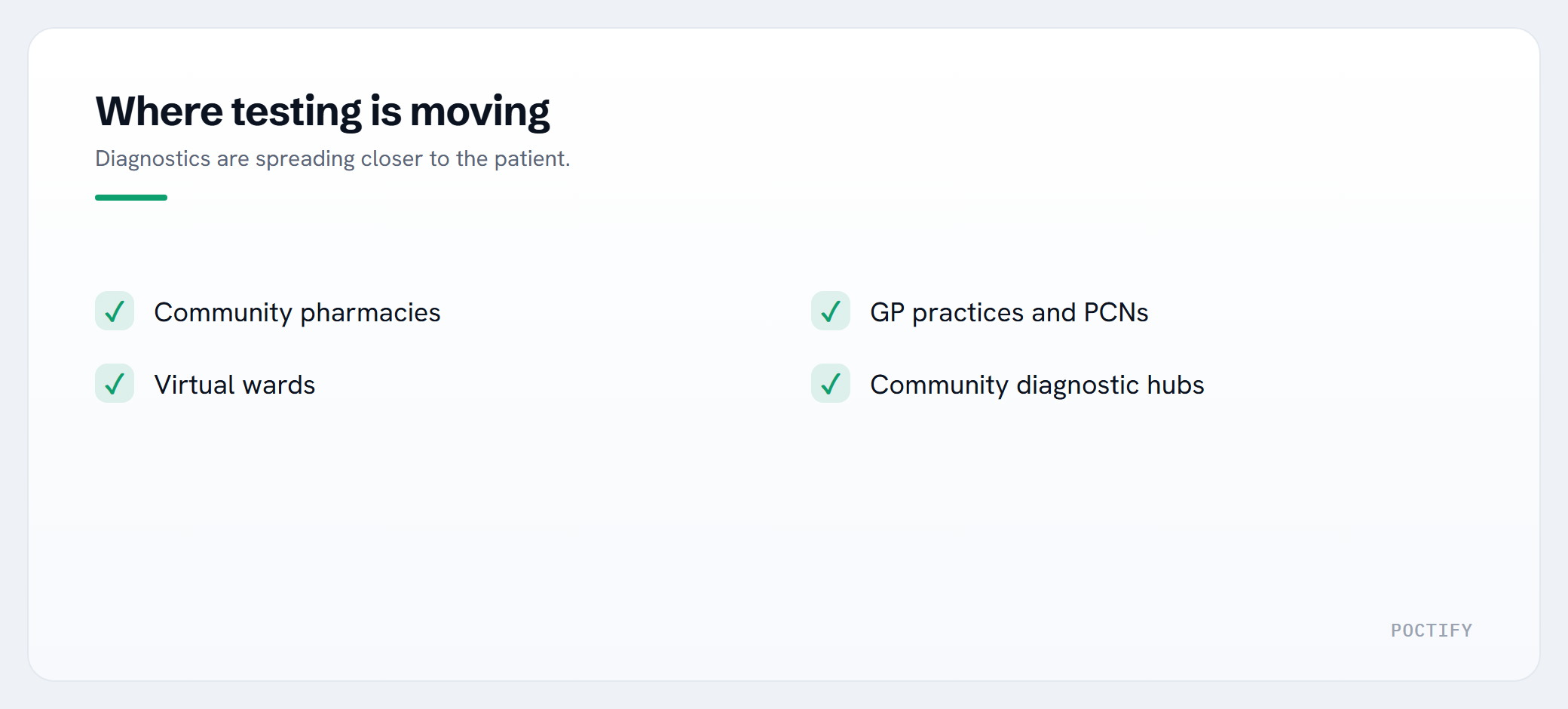
The clinical case for moving testing closer to patients is settled. The operational problem it creates is not, and it lands with commissioners, primary care network managers and transformation leads: more sites, more devices, more people running tests, and no obvious way to hold one trustworthy record of who was tested, on what device, by whom, and whether the result can be relied on.
This article maps the shift to decentralised diagnostics in plain language and sets out what it actually demands of the people who plan and pay for it.
This article is for educational and operational purposes and is not medical advice. It does not guide the diagnosis, interpretation or treatment of any individual patient.
What decentralised diagnostics means in 2026
Decentralised diagnostics is the deliberate move of testing out of the central laboratory and towards the patient: into community settings, the high street and the home. You will hear it described as near-patient testing, point-of-care testing or simply testing closer to home. The labels differ, the direction is the same. The test happens where the patient is, and the result is meant to be available in minutes rather than days.
What changes is not only the location. It is the number of places a single patient might be tested in a year, and the number of separate organisations now generating results that have to end up in one coherent clinical picture.
Four forces pulling testing out of the lab
Community diagnostic centres
The community diagnostic centre programme set out to open around 160 centres across England, offering checks such as imaging, cardiorespiratory tests and blood tests away from acute hospital sites. For a patient that means a simpler trip and a faster result. For a commissioner it means a new tier of diagnostic capacity that has to report into the same pathways as the hospital it was built to relieve. Tests such as HbA1c for long-term diabetes monitoring now begin in buildings that historically never generated a laboratory record at all.
Pharmacy First and community pharmacy
Pharmacy First, launched in England in 2024, moved assessment and supply for seven common conditions into community pharmacies. It normalised the idea that a clinical decision can be made on the high street. Near-patient testing is the logical next step, and interest in CRP testing to support antibiotic decisions for respiratory symptoms continues to grow. Every pharmacy that runs a test becomes a small diagnostic site with its own record-keeping duty and its own quality obligations.
Virtual wards and hospital-at-home
Virtual wards now provide thousands of beds in patients’ own homes, with NHS England targeting roughly 40 to 50 virtual ward beds per 100,000 people. Patients who would once have occupied an acute bed are monitored where they live, often with point-of-care tests that are meant to flag deterioration early enough to act. The result has to reach the responsible clinician quickly and unambiguously, because the safety of the model depends on it.
Home and self-testing
Self-testing has moved well beyond pregnancy kits, helped by the public’s comfort with self-sampling that grew through the pandemic. Patients now generate results at home and expect those numbers to mean something to their clinician. A result a patient cannot get into their record is, in clinical terms, a result that did not happen.
The problem all four share: many sites, one patient, no single record
Look across those four forces and the same operational fault line runs through every one of them. Each adds testing locations and devices. None of them, on its own, guarantees that the result reaches the patient’s record in a form a clinician can trust.
The consequences are practical:
- A patient tested at a pharmacy, a community centre and at home in the same month can hold three results that never meet.
- A clinician cannot tell at a glance which device produced a number, who ran it, or whether quality control was in date that day.
- An ICB cannot report on activity it cannot see, and cannot govern quality it cannot measure across sites.
- Repeat testing rises because the earlier result is invisible, which wastes the very capacity that decentralisation was meant to free up.
This is the point most often missed in 2026 planning. Decentralised diagnostics is not really a testing problem. It is a record and governance problem wearing a testing costume.
Why buying more analysers will not fix it
It is tempting to treat near-patient testing as a procurement exercise: choose devices, place them, train staff, count tests. Devices are the easy part. Every new analyser added to a patch without a plan for the record makes the underlying problem larger, because it creates another stream of results in another format in another location.
The providers who come out ahead are not the ones with the most analysers. They are the ones who solve the layer above the devices: a single trustworthy record, and the governance that keeps it credible. Crucially, that layer has to work with the devices and systems you already use, rather than forcing every site onto one brand of machine.
What good looks like: the record and governance layer
One result per patient, wherever the test ran
Every result, whether from a community centre, a pharmacy or a home device, should land against the right patient in one place, with the device, operator, time and quality status attached. That single record is what lets a clinician act on a number with confidence, and what lets a commissioner see real activity instead of estimates.
Quality control and competency that travel
A result is only as trustworthy as the quality control behind it and the competence of the person who produced it. Across many sites that means quality control schedules, reagent lot tracking and operator training that are visible centrally, not buried in a paper logbook in each location. Getting this right is the difference between quality control that survives an audit and a trail that collapses the first time someone inspects it.
Governance and oversight that scale with the sites
Every site you add multiplies oversight: accreditation expectations, audit, incident handling and routine reporting. A workable model lets a small central team see every location at once, spot a device drifting out of control or a missed quality check, and act before it reaches a patient. ISO 15189:2022, the international standard for the quality and competence of medical laboratories, sets out in broad terms what is expected of a testing service. Those principles carry into near-patient settings, and you should consult the official standard for the detail rather than rely on a summary.
A practical starting point for commissioners and PCN managers
If you are planning or expanding near-patient testing, a handful of questions separate the durable plans from the expensive ones:
- For every proposed testing site, where does the result go, and who can see it next to the rest of the patient’s record?
- Can you see quality control status and operator competency across all sites from one place, in close to real time?
- When a device or an operator produces a questionable result, how quickly would you actually know?
- Does your reporting capture activity from every site, or only the ones already linked to the hospital?
- Will the chosen approach work with the devices and systems you already use, or does it tie you to one supplier’s hardware?
If you cannot answer the first question for every site, that is the gap to close before you buy anything else.
The shift is not slowing down
Testing closer to home is one of the clearer point of care testing trends for 2026, driven by patient demand and capacity pressure as much as by policy. The centres, pharmacies, virtual wards and home kits will keep multiplying. The organisations that benefit will be those that treat the record and governance layer as the main build, not an afterthought bolted on once the analysers have arrived.
If you are mapping near-patient testing across your sites and want to think through the record and governance layer before you commit to hardware, Talk to POCTIFY. We work with point-of-care testing services to fit record-keeping and oversight to how your sites actually run, using the devices and systems you already have.
Frequently asked questions
What is decentralised diagnostics?
Decentralised diagnostics is the deliberate move of testing out of the central hospital laboratory and towards the patient: into community diagnostic centres, high-street pharmacies, virtual wards and the home. The aim is a faster result, available close to where the patient is. The operational challenge it creates is keeping one trustworthy record when testing happens across many sites and devices.
What is the difference between near-patient testing and point-of-care testing?
In everyday use the two terms describe the same thing: a test performed close to the patient with a result available quickly, rather than sent to a distant laboratory. Some teams use near-patient testing for community or clinic settings and point-of-care testing for the bedside, but the operational issues, such as quality control and getting results into one record, are identical.
Do community diagnostic centres replace the hospital laboratory?
No. Community diagnostic centres add capacity closer to patients and relieve pressure on acute sites, but they sit alongside the central laboratory rather than replacing it. That makes the record and governance layer more important, because results now originate in more places and still need to come together in one clinical picture.
How do you keep quality control consistent across many testing sites?
Consistency comes from making quality control schedules, reagent lot tracking and operator competency visible centrally rather than logged separately at each site. A central team should be able to see, in close to real time, which sites are in control, which checks are overdue and where a device may be drifting, so issues are caught before they reach a patient.
What should commissioners prioritise when expanding near-patient testing?
Start with the record, not the hardware. For every proposed site, confirm where the result will go and who can see it next to the rest of the patient’s record, whether quality and competency are visible across all sites, and whether the approach works with the devices and systems already in use. If you cannot answer those questions, close that gap before buying more analysers.