The expensive mistake: buying the analyser first
Most clinics set up point-of-care testing in the wrong order. The analyser arrives, it is plugged in near reception, and someone runs a patient sample that same afternoon. Quality control, result recording and audit get sorted out “once we are up and running”. Months later the practice manager is hunting through paper logs before an inspection, results are sitting in three different places, and nobody can say with certainty who ran a given test or whether the device was in control that day.
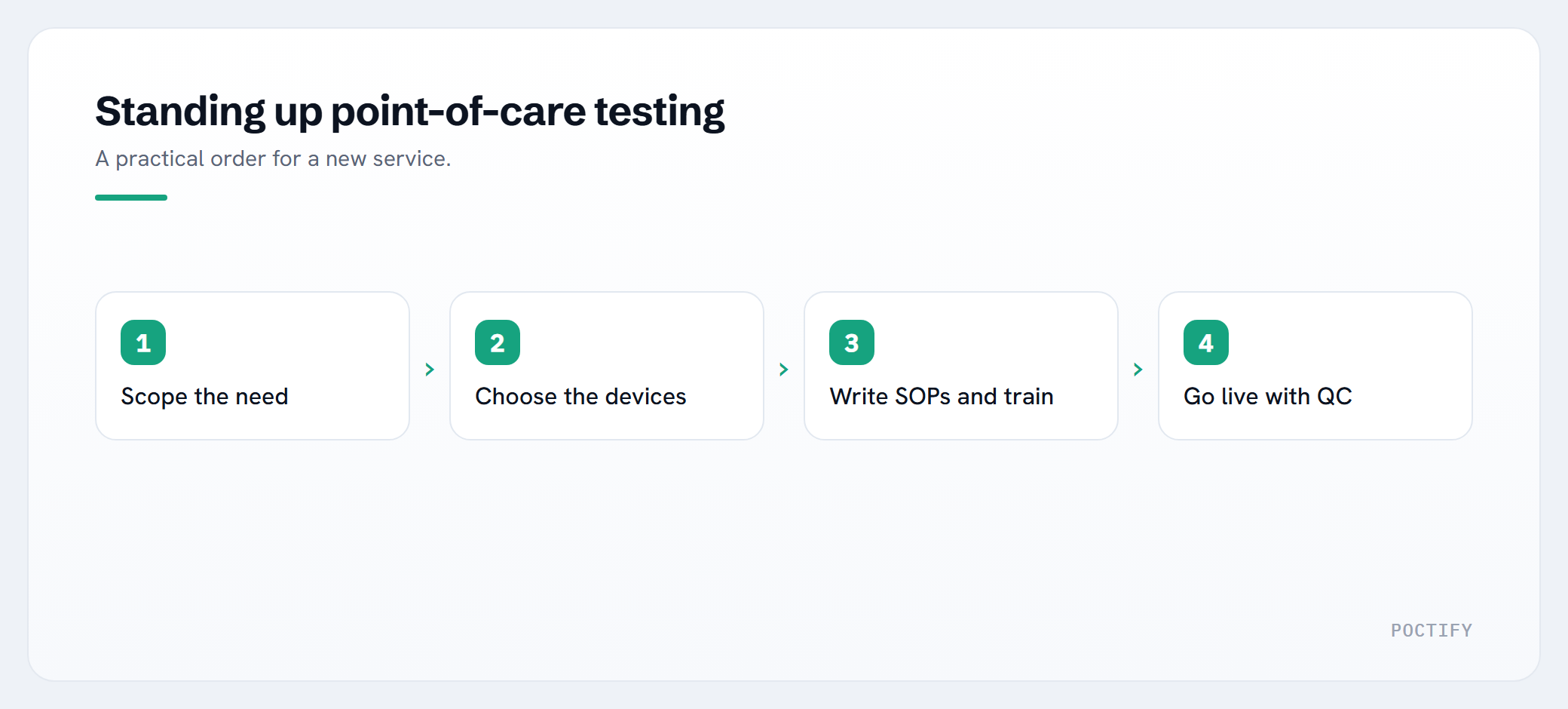
This is the costliest error in POCT implementation, and it is a sequencing problem more than a skills problem. The device is the easy part. The work that protects patients, and that an assessor will actually ask about, sits around the device: the menu you offer, the person accountable for it, the quality checks, and the way every result is captured and stored. Get that order right and the analyser becomes your last decision, not your first.
Here is a practical checklist to set up point-of-care testing in a clinic, in the order that saves money and rework.
Step 1: Define the test menu before you shortlist devices
Start with the clinical question, not the catalogue. Write down which decisions you want testing to support at the point of care, then work back to the analytes that answer them.
- A same-day diabetes review clinic needs HbA1c.
- A minor-illness or respiratory service may want CRP to support antibiotic decisions.
- An urgent or acute setting might prioritise lactate and a basic metabolic panel including potassium.
For each analyte, record the expected daily volume, the turnaround time you actually need, the sample type, and whether a result will change what you do in that visit. If a test will not change a decision on the day, it probably does not belong on a point-of-care menu yet. This single page becomes your specification. It tells you how many devices you need, the throughput required, and the running cost per result long before a sales conversation.
Step 2: Name a responsible person before anything is switched on
Every POCT service needs a named lead, sometimes called the POCT coordinator. This is not a formality. Diffuse ownership is the reason logs go unfilled and faults go unreported.
Give that person clear responsibilities:
- Owning the standard operating procedures for each test.
- Approving who is trained and signed off to test.
- Reviewing quality control and acting when it fails.
- Logging device faults, reagent lot changes and corrective actions.
- Being the point of contact for any external review.
In small clinics this can be part of someone’s existing role, but it must be written down with named cover for leave. POCT device management falls apart when “everyone” owns it, because that means no one does.
Step 3: Set quality control and training before the first patient
Quality control
Quality control (QC) is how you prove a result can be trusted, not an optional extra. Before go-live, decide and document:
- Which control materials and levels you will run, and how often. Commonly this is at least once on each testing day and after every new reagent lot.
- The acceptable range for each control, and the rule for when a control falls outside it: stop testing, investigate, and do not release patient results until the issue is resolved.
- Who reviews QC, and how a failure is escalated.
Standards such as ISO 15189:2022 set out expectations for quality in point-of-care and near-patient testing. You do not need to memorise the clauses, but you should understand in plain terms what they expect, namely defined procedures, trained staff, documented QC and traceable records. Consult the official standard or your accreditation body for the detail.
Training and competency
Untrained operators are a common source of unreliable results. Build a short competency framework before launch: initial training against each procedure, an observed assessment, and periodic re-assessment, with annual review being typical. Keep a simple record of who is signed off for which test and when their competency is next due. Many devices can restrict testing to operators on the approved list, which turns your training record into an active control rather than a folder nobody opens.
Step 4: Decide how results are captured and audited
This is the step clinics defer, and it is the one that hurts most later. Decide before the first patient how each result will be recorded, where it lives, and how you would reconstruct what happened.
A sound point of care testing workflow answers four questions for every result:
- Who ran it, on which device, and when.
- Whether the device was in control at that time.
- How the result reached the patient record without manual retyping.
- How a reviewer can find it again months later.
Manual transcription into a patient record is slow and a known source of error: a value read off a screen and typed in by hand can be transposed or attached to the wrong patient. Managing point of care test results well means results flow from the device into the record with the operator, device and timestamp attached, and with an audit trail you can search. If your plan for results is a notebook beside the analyser, the plan is the problem.
Step 5: Do not lock yourself into one analyser
Here is the trap that costs clinics the most over time: choosing a single supplier’s closed ecosystem because it is the easy option on day one. Your menu will grow. You may add a second site, inherit a device when you take on another practice, or replace an analyser when the running cost no longer makes sense. If your records and audit trail only work with one manufacturer’s box, every one of those changes becomes a painful migration.
Choose a setup that works with the devices and systems you already use, so the way you capture results, run QC and audit stays consistent across whatever sits on the bench. That keeps your data in one searchable place, keeps training consistent, and keeps your options open on price and clinical fit. The device should serve the workflow. The workflow should never be a hostage to the device.
Your checklist to set up point-of-care testing in a clinic
Before the first patient sample, you should be able to tick all of these:
- The test menu is defined, with volume, turnaround and clinical purpose per analyte.
- A named POCT lead is in place, with documented duties and cover.
- Standard operating procedures exist for every test on the menu.
- QC materials, frequency, acceptance rules and failure actions are agreed and documented.
- Operators are trained, assessed and recorded, with re-assessment dates set.
- Every result has a defined path into the patient record with operator, device and timestamp.
- The audit trail is searchable and not tied to a single manufacturer.
Work through these in order and POCT implementation stops being a scramble and becomes a controlled launch. The clinics that do this well are not the ones with the most expensive analyser. They are the ones who decided how results, quality and audit would work before they ran a single patient.
This article is for operational and educational purposes only. It is not medical advice and does not replace clinical judgement or your local regulatory requirements.
Talk to POCTIFY
If you are standing up a new point-of-care testing service, or trying to bring an existing one under control, we can help you design a setup around the devices and systems you already use. Talk to POCTIFY for tailored, practical support.
Frequently asked questions
What is the first step when setting up point-of-care testing in a clinic?
Define your test menu before choosing a device. List the clinical decisions testing needs to support, then the analytes that answer them, with expected volume, turnaround and sample type for each. The menu, not the analyser, should drive every later choice.
Who should be responsible for point-of-care testing in a clinic?
Name a single POCT lead, sometimes called a coordinator, before you go live. They own the procedures, approve who is trained to test, review quality control, and log faults and corrective actions. In small clinics this can sit within an existing role, but it must be documented with named cover.
How often should quality control be run on POCT devices?
Run controls often enough to catch a problem before it reaches patients. In practice this usually means at least once on each testing day and after every new reagent lot, with defined acceptance ranges and a clear rule to stop testing and investigate when a control fails. Follow your device guidance and accreditation requirements.
How should point-of-care test results be recorded?
Each result should reach the patient record with the operator, device and timestamp attached, and stay searchable for later review. Avoid manual retyping where you can, since transcribing values by hand is a known source of error and is difficult to audit.
Can one system work with different analysers?
Yes. Choosing a setup that works with the devices and systems you already use lets you capture results, run QC and audit consistently across different analysers. That keeps your records in one place and avoids being locked into a single supplier as your test menu grows.