Pharmacy First opened the door. Your records have to walk through it
Pharmacy First has changed what a community pharmacy can be paid to do, and it has changed who walks in expecting a test rather than a recommendation. That is the opportunity. The problem sits in what happens after the analyser beeps. A printout in a drawer, or a reading copied onto a paper log that nobody can locate six months later, is not a record you can defend when a commissioner, a GP practice or an inspector asks to see it.
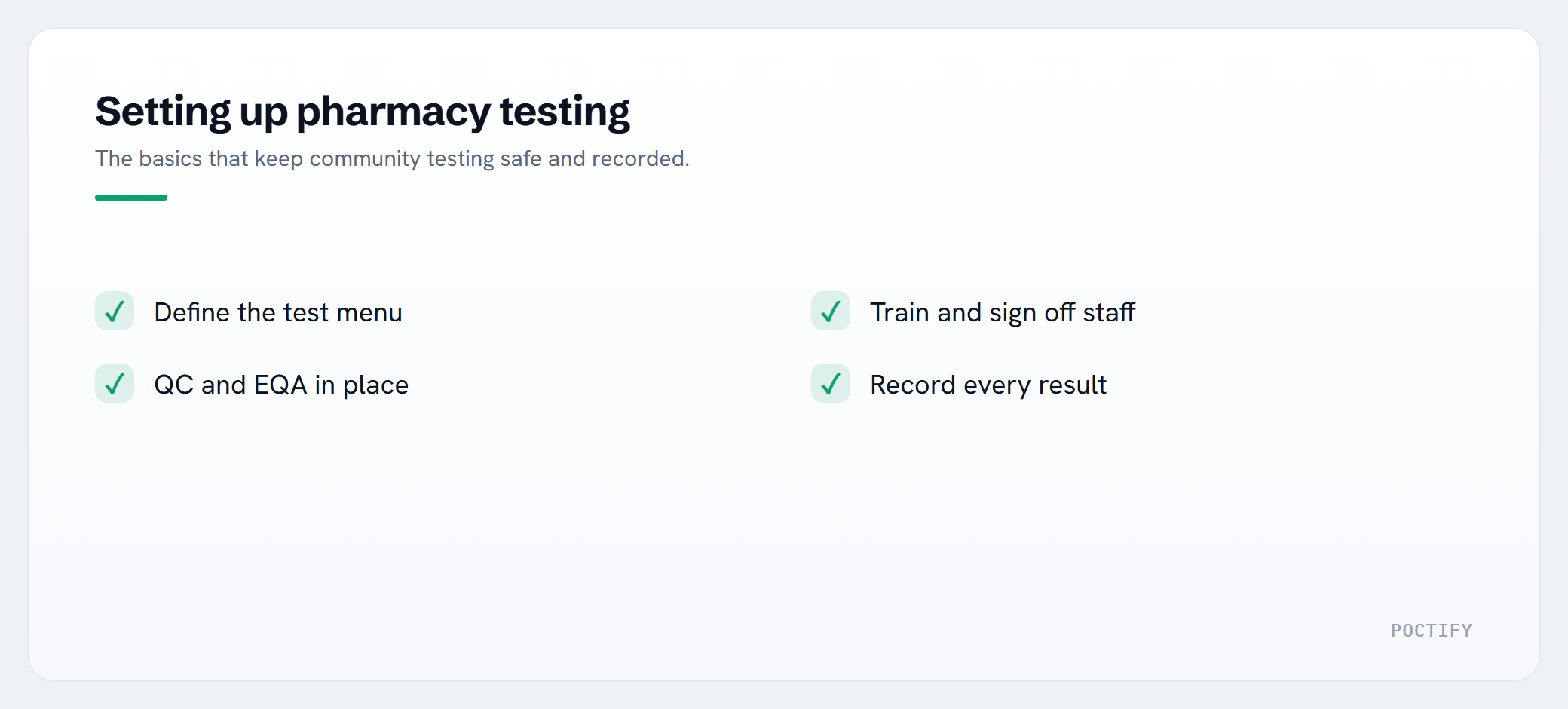
Choosing which tests to offer is the easy decision. The harder work, and the part that protects your income and your registration, is the operating model around the result: how every test is captured, how quality control is evidenced, and how each operator signs off what they did. Get that right and community pharmacy point-of-care testing becomes a service you can scale. Get it wrong and one awkward audit can close it down.
What Pharmacy First changed, and what it did not
The Pharmacy First service in England gave pharmacies defined clinical pathways and a payment structure to match. It normalised the idea that a pharmacy is a place where a patient is assessed and a decision is recorded, not only where a product is sold. For many owners that has been the trigger to add near-patient testing, both inside NHS-commissioned activity and as private paid services running alongside it.
What it did not change is the standard your records are held to. Whether a test is NHS-funded or paid privately, the expectation is the same: a traceable result, linked to a named patient, produced on a device that was working correctly, by an operator trained to use it. Pharmacy First point-of-care testing raised the volume of tests without lowering the bar on documentation. That gap, between more testing and the same evidence requirement, is where most services get into trouble.
A community pharmacy point-of-care testing menu that fits your footfall
Match the menu to demand you can actually see
A test menu should follow the patients already coming through your door, not a wish list. Look at your repeat dispensing, your seasonal pressure and the questions your counter team fields every week. Three patterns usually justify a device.
Respiratory pressure in winter points towards CRP testing. Pharmacy CRP testing supports conversations about whether an antibiotic is likely to help, which fits the antimicrobial stewardship message pharmacies are already asked to carry.
Long-term condition demand points towards HbA1c. HbA1c testing in pharmacy suits diabetes screening for at-risk adults and monitoring for patients who struggle to get a timely practice appointment.
Cardiovascular risk and NHS Health Check style activity points towards a lipid panel. Anticoagulation monitoring points towards INR. A handful of pharmacies add Strep A or urinalysis where local pathways support it.
Start narrow, then widen
Setting up POCT in a pharmacy works best when you begin with one or two analytes you can run well every day, rather than five you run occasionally. A device used daily keeps operators competent and keeps quality control routine. A device used twice a month produces rusty staff, expired controls and results you end up second-guessing. Prove the model on a small menu, then add analytes once the recording and quality control habits are embedded.
The operating model: one place for every result
This is the part that matters most. A test menu only holds up when every result lands in a single record you can search, not across a printer roll, a spreadsheet and three sticky notes.
What to capture on every single test
For each test, regardless of analyte, you want a record that contains:
- Patient identifier and confirmation of consent to test
- Date and time of the test
- The operator who ran it, named, not initialled
- The device used and its identifier, plus the reagent or cartridge lot number and expiry
- Quality control status at the time of the test
- Sample type and any relevant collection note
- The result with units and the reference range applied
- The action taken: advice given, sale, referral, or onward communication to the patient’s GP
- Who reviewed and signed off the result
The lot number and quality control status are the fields most paper systems drop, and they are the first two an auditor asks for. If a reagent lot is later recalled, you need to find every patient tested on it within minutes, not days. A record that captures this at the point of testing, and that works with the devices and systems you already use, removes the manual transcription step where errors and omissions creep in.
Quality control you can show, not just do
Running controls is not the same as being able to prove you ran them. Build quality control into the daily rhythm: run the levels your manufacturer specifies on the schedule they specify, record the control lot and expiry, and flag any result outside range before a patient is tested. Where an external quality assessment scheme exists for your analyte, enrol and keep the reports.
The test of a good system is simple. If someone asks for your CRP control results for a date three months ago, can you produce them with the operator, the lot and the pass or fail attached, in under a minute? If the answer involves searching a drawer, the service is not audit-ready.
Operator competency and sign-off
Every result should trace back to a named operator who was trained and signed off as competent on that device. Keep a current list of authorised operators, the date of their training, the date of their last competency check and who assessed them. When a new starter joins, they should not be releasing a recorded result until that sign-off exists. This is also what protects your responsible and superintendent pharmacists: clear delegation, clear competence and clear accountability for each result.
How audits actually go
An audit, whether from a commissioner, an internal review or a professional inspection, rarely starts with the device. It starts with a result and works outwards. An assessor picks a patient record and asks you to walk the chain: who tested, on what device, with which lot, what the quality control showed that day, what the result was, and what you did with it.
If each of those answers lives in one record, the audit is short and you pass. If the answers are scattered, you spend the visit reconstructing history and hoping nothing is missing. The difference is not how good your clinical judgement was on the day. It is whether your recording captured the evidence at the moment of testing. Services that treat the record as the product, not the printout, are the ones that survive scrutiny and keep their commissioning.
A practical readiness check: pick three random tests from the last quarter and try to assemble the full chain yourself. If you cannot, neither can an auditor, and that is the work to fix before you widen the menu.
Common mistakes worth avoiding
- Treating the printout as the record. Thermal paper fades and printouts get lost. The durable record is the one you can search.
- Logging results without quality control behind them. A result with no control status is hard to defend.
- Initials instead of names. Traceability needs a person, not a squiggle.
- Letting reagent stock expire on the shelf. Track lots and expiry as carefully as the results themselves.
- Adding analytes faster than competence. Each new test needs its own training, controls and sign-off.
Build the operating model first and the menu can grow safely around it. Build the menu first and you spend the next year retrofitting records you should have captured from day one.
This article is for operational and educational use and is not medical advice. Clinical decisions remain with the responsible clinician.
If you are setting up or tightening point-of-care testing in your pharmacy and want the recording, quality control and sign-off to hold up under Pharmacy First, Talk to POCTIFY about support tailored to your devices and your footfall.
Frequently asked questions
Do I need point-of-care testing to deliver Pharmacy First?
No. The core Pharmacy First pathways are built around clinical assessment, and several use symptom scoring rather than a device. Many pharmacies add point-of-care testing alongside the service, both within commissioned activity and as private paid tests, because it supports clearer decisions and brings patients in. If you do test, the recording and quality control standards apply regardless of whether the test is NHS-funded.
Which point-of-care tests are most worth offering first?
Follow your footfall. CRP suits winter respiratory demand and antibiotic conversations, HbA1c suits diabetes screening and monitoring, and a lipid panel suits cardiovascular risk work. Start with one or two analytes you can run every day so operators stay competent and controls stay routine, then widen the menu once the recording habit is embedded.
What exactly do I need to record for each test?
At minimum: the patient and their consent, date and time, the named operator, the device and reagent lot, the quality control status, the result with units and reference range, the action taken, and who signed it off. The lot number and control status are the fields paper logs usually miss and the first an auditor asks for.
How do I make pharmacy CRP testing and HbA1c testing audit-ready?
Run and record the manufacturer’s controls on schedule, enrol in an external quality assessment scheme where one exists, and keep every result in a single searchable record rather than on printouts. The benchmark is being able to produce any past result, with its operator, lot and control status, in under a minute.
Who is accountable for results in the pharmacy?
Accountability sits with the responsible pharmacist on duty and, at organisation level, the superintendent pharmacist. That is why named operators, competency sign-off and clear delegation matter: each result should trace to a trained person, with the pharmacist’s oversight recorded.
Can point-of-care testing work with the systems I already have?
Yes. A good approach captures results from your existing devices into one record without re-keying, so you avoid transcription errors and keep quality control and sign-off in the same place. Talk to POCTIFY about fitting this to your current setup.