
It is 3am in the department. A point-of-care lactate of 3.1 mmol/L flashes up on a febrile, unwell patient. The number feels loud. It sits above the line you remember as normal and below the line you remember as dangerous, and the temptation is to treat the figure rather than the patient. Read it one way and you under-call someone who is quietly deteriorating. Read it another way and you escalate a patient whose lactate is raised for a reason that has little to do with shock.
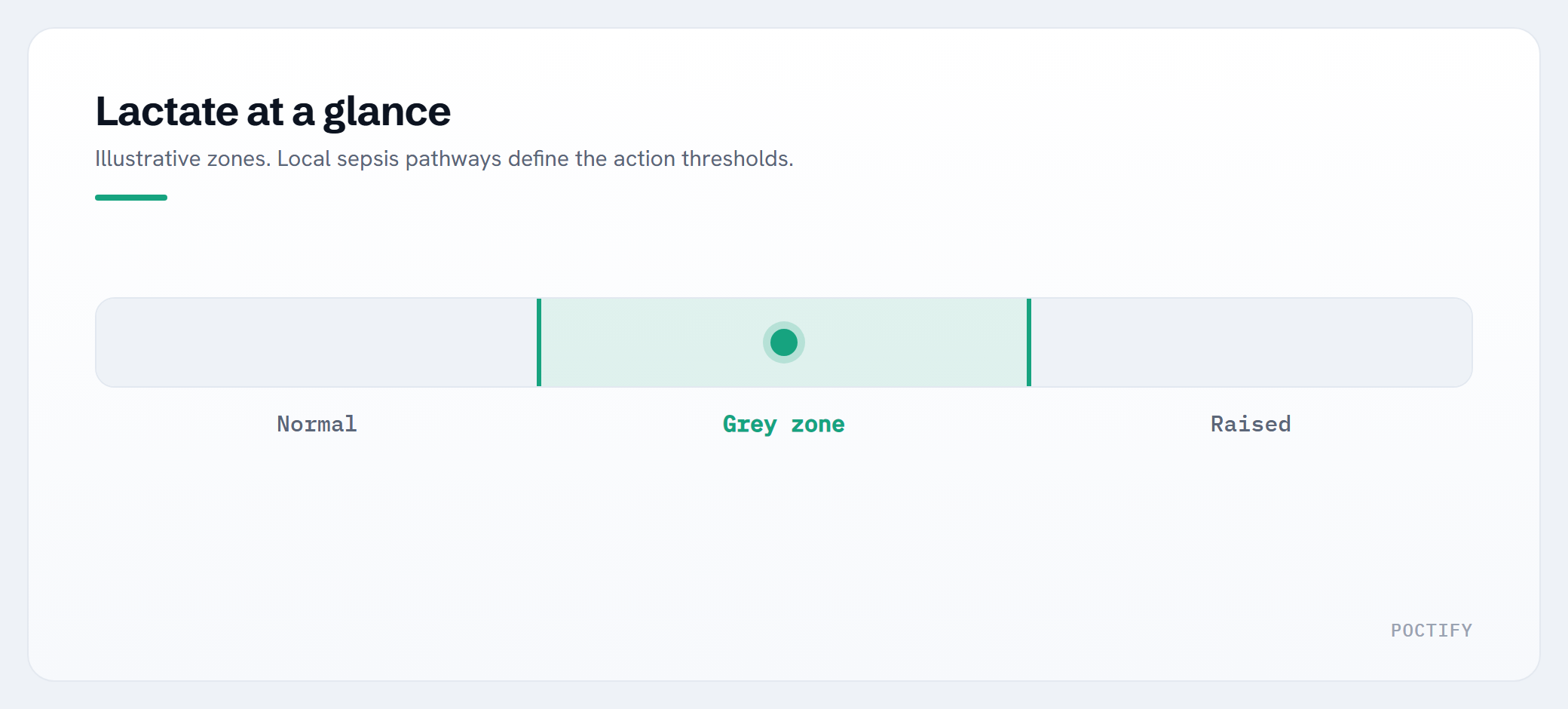
The answer is not a better single number. It is knowing the genuine point-of-care lactate normal range, what the two clinically loaded thresholds actually signal, why the 2 to 4 mmol/L band is so often misread as septic shock, and why the trend over the next hour or two tells you far more than the first value ever can.
This article is educational and operational only. It does not provide diagnosis or treatment guidance for any individual patient. Always follow your local sepsis pathway and clinical judgement.
Point-of-care lactate: the normal range
In a resting, well person, blood lactate is low. The usual quoted range is roughly 0.5 to 1.6 mmol/L, and most laboratories and point-of-care analysers treat anything below 2.0 mmol/L as within range. Lactate is produced continuously by tissues and cleared mainly by the liver and kidneys, so a normal value reflects a balance between production and clearance, not the absence of either.
Two practical points matter at the bedside. First, point-of-care devices report whole-blood lactate, and a handheld result is a snapshot of that balance at one moment. Second, the same analyte behaves very differently depending on the patient in front of you, which is why the same figure can be reassuring in one person and a warning in another. The reference background for this marker, including units and physiology, is summarised in the lactate entry in the POCTIFY Analyte Explorer.
The two thresholds that change decisions
Above the normal range, two numbers do most of the clinical work.
2 mmol/L: the flag
A lactate above 2 mmol/L is the level at which most sepsis pathways ask you to pay attention. It is a marker of possible tissue stress and is built into the formal definition of septic shock. It is a flag, not a diagnosis. On its own, a value just over 2 in a haemodynamically stable patient does not establish shock and should not, by itself, trigger the most aggressive end of your protocol.
4 mmol/L: the alarm
A lactate of 4 mmol/L or more carries a markedly higher risk and, in suspected sepsis, usually warrants urgent senior review, prompt resuscitation and close monitoring. Across large cohorts this level is consistently associated with worse outcomes. A value this high deserves a fast, deliberate response while you work out the cause.
The grey zone: why 2 to 4 mmol/L is not septic shock
This is where the literature flags a recurring trap. A reading in the 2 to 4 mmol/L band is frequently read as septic shock when, by definition, it is not.
The Sepsis-3 consensus (Singer and colleagues, JAMA, 2016) defines septic shock as a subset of sepsis identified by a vasopressor requirement to maintain a mean arterial pressure of 65 mmHg or more, together with a serum lactate above 2 mmol/L, persisting after adequate fluid resuscitation and in the absence of hypovolaemia. That combination carries a hospital mortality reported in excess of 40 per cent.
Notice what the definition requires. Not just a raised lactate, but a raised lactate plus a vasopressor-dependent blood pressure plus adequate fluid resuscitation already given. An isolated lactate of 2.8 mmol/L in a patient who is talking to you, perfusing well and has not yet been fluid-challenged does not meet that bar. Treating the number as if it does risks over-resuscitation, unnecessary central access and vasopressor use, and a misleading early label that follows the patient through their admission.
The grey zone is real, and it cuts both ways. It should raise your index of suspicion and shorten the interval to your next measurement. It should not, on its own, be equated with shock.
Lactate rises without hypoxia, too
Clinicians often treat lactate as a pure oxygen-debt signal. Much of the time, in shock, it is. But a meaningful proportion of raised values are non-hypoxic, sometimes called type B hyperlactataemia, and missing this leads to over-treatment of patients who are not under-perfused.
Common non-hypoxic contributors include:
- Liver disease. The liver is the main site of lactate clearance, so significant hepatic impairment raises baseline lactate even without shock.
- Drugs. Metformin, particularly with renal impairment, beta-2 agonists such as high-dose salbutamol, adrenaline infusions, linezolid and some antiretrovirals can all push lactate up.
- Heavy exertion or seizure. Intense muscle activity, including a recent generalised seizure or a struggle before arrival, can transiently raise lactate well into the abnormal range, then it falls quickly.
- Other causes. Thiamine deficiency, some malignancies, severe alkalaemia, and diabetic ketoacidosis can each elevate lactate.
None of these means you ignore a high reading. It means you interpret it alongside the history, perfusion, blood pressure and the rest of the picture, and you re-check it. A lactate of 3.5 mmol/L after a witnessed seizure that halves on repeat tells a very different story from one that climbs. Where infection is the question, lactate sits alongside other markers such as CRP and the clinical assessment, never in isolation.
Capillary, venous or arterial: does the sample site matter?
For point-of-care lactate, sampling site is not a technicality. It changes the number.
A systematic review in the American Journal of Emergency Medicine (2019) examined agreement between arterial and peripheral venous lactate and found venous sampling reasonable for screening, though not perfectly interchangeable with arterial values. Capillary fingertip sampling is more variable still. Studies have reported fingertip capillary lactate reading substantially higher than arterial in intensive care patients, with the earlobe closer but still raised, and poor precision against venous reference methods in some emergency department series.
The practical implications:
- Use capillary lactate as a fast screen, not a precise figure. A normal capillary result is reassuring; a raised one warrants confirmation by a venous or arterial sample before you build major decisions on the exact value.
- Keep the sample source consistent when you trend. Comparing a fingertip value against a later venous value can manufacture a fall or a rise that is really just a change of site.
- Record the source every time. A lactate of 3.0 means something different depending on where it came from, and the next clinician needs to know.
A single value lies; serial lactate and clearance tell the story
The most important shift in thinking is from the snapshot to the trajectory. A first lactate is a starting point. What happens next is the prognostic signal.
Lactate clearance, the percentage fall between an initial and a repeat measurement, is widely used because the change tracks the response to treatment better than the opening figure. A common operational target is a reduction of at least 10 per cent within the first few hours, though the exact cut-off and timing vary between studies and pathways.
The evidence base supports this. A systematic review and meta-analysis in Critical Care Medicine (2014) found that lactate clearance predicted all-cause mortality in critically ill patients, and later reviews report that clearance and the lactate at later time points, rather than the initial value alone, are independently associated with outcome. In other words, the patient whose lactate of 4.0 mmol/L falls to 2.5 after fluids is on a different path from the one whose 4.0 holds or climbs, even though they started in the same place.
This is also why a single 2.8 mmol/L should rarely be the end of the assessment. Repeat it. The direction of travel resolves much of the grey zone that a lone number creates.
Getting point-of-care lactate right operationally
The clinical interpretation only holds if the result is sound and easy to act on. A few things consistently make or break that at the point of care:
- Sample handling. Lactate keeps being produced in a tube of blood after collection, so delay before analysis falsely raises the result. A prolonged tourniquet and a clenched fist can do the same. Point-of-care testing helps precisely because it shortens the time from sample to result.
- Quality control. A lactate that drives resuscitation is only as trustworthy as the device producing it. Routine quality control and competent operators are not optional extras for a marker with these stakes.
- Capture the context. Each result is more useful when it is recorded with its sample source, the time, and ideally the patient’s blood pressure and fluids given, so the next reviewer can interpret it and the trend is visible.
- Make the trend easy to see. Serial lactate only changes decisions if the values sit together where the team can read them, rather than scattered across charts.
This is the practical layer POCTIFY supports. The aim is for point-of-care results to be captured cleanly, with their source and timing, and surfaced as a clear trend, using software that works with the devices and systems you already use. If you want help getting serial point-of-care results captured and read at a glance, you can Talk to POCTIFY.
The bottom line
The point-of-care lactate normal range is below about 2 mmol/L. Above 2 is a flag, above 4 is an alarm, and the 2 to 4 mmol/L band is a grey zone, not a diagnosis of septic shock, which under Sepsis-3 also requires vasopressor-dependent hypotension after fluid resuscitation. Lactate rises for non-hypoxic reasons too, sampling site shifts the number, and the trend over time, not the first reading, carries the prognosis. Interpret the figure in context, repeat it, and watch where it goes.
This content is educational only and is not medical advice or a substitute for clinical assessment.
Frequently asked questions
What is the normal range for point-of-care lactate?
In a resting, well person, blood lactate is typically around 0.5 to 1.6 mmol/L, and most point-of-care analysers and laboratories treat values below 2.0 mmol/L as within range. Point-of-care devices report whole-blood lactate as a snapshot at one moment, so a single value should be interpreted alongside the clinical picture.
Does a lactate of 3 mmol/L mean septic shock?
No. A value of 3 mmol/L sits in the 2 to 4 mmol/L grey zone. The Sepsis-3 consensus (Singer et al., JAMA, 2016) defines septic shock as a vasopressor requirement to keep mean arterial pressure at 65 mmHg or more plus a lactate above 2 mmol/L, persisting after adequate fluid resuscitation. A raised lactate alone, without that haemodynamic picture, does not meet the definition.
What causes a raised lactate other than sepsis?
Several non-hypoxic causes raise lactate, sometimes called type B hyperlactataemia. They include liver disease, drugs such as metformin, high-dose beta-2 agonists, adrenaline, linezolid and some antiretrovirals, heavy exertion or a recent seizure, thiamine deficiency, some malignancies and diabetic ketoacidosis. These should be considered before attributing every raised lactate to under-perfusion.
Is capillary fingertip lactate accurate enough for sepsis screening?
Capillary fingertip lactate is useful as a fast screen but is less precise than venous or arterial sampling and can read meaningfully higher. A systematic review in the American Journal of Emergency Medicine (2019) found venous sampling reasonable for screening but not fully interchangeable with arterial values. Confirm an important raised capillary result with a venous or arterial sample and keep the sample source consistent when trending.
What is lactate clearance and what target is used?
Lactate clearance is the percentage fall between an initial and a repeat measurement, and it tracks the response to treatment better than the opening value. A commonly used operational target is a reduction of at least 10 per cent within the first few hours, though cut-offs and timing vary by pathway. A systematic review and meta-analysis in Critical Care Medicine (2014) found lactate clearance predicted mortality in critically ill patients.