Most clinics do not set out to put a wrong number in a patient record. It happens one keystroke at a time. A staff member reads a value off an analyser screen, turns to the keyboard, and types it into the record. Ninety-nine times out of a hundred it is fine. The trouble is the hundredth time, and the fact that you rarely find out which time it was.
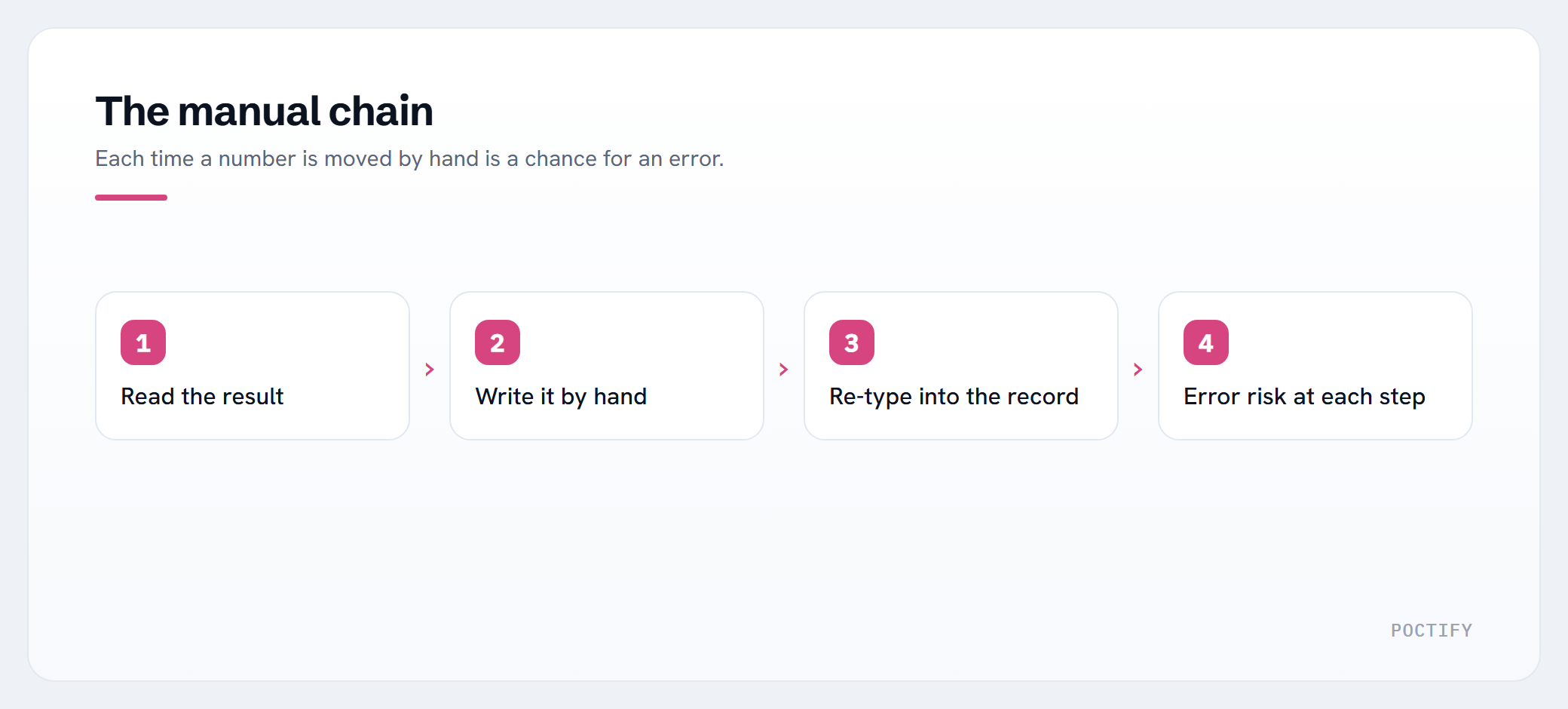
If your clinic runs point-of-care testing (POCT), manual transcription is probably woven through the working day without anyone naming it as a risk. Yet every retyped result is a fresh chance for a digit to drop, a decimal point to shift, or a stray character to be accepted as if it were a real value. This article looks at what the evidence says about manual transcription error in point-of-care testing, why these mistakes are so hard to catch, and what changes when results are captured straight from the devices you already use.
This article is for educational and operational purposes only and is not medical advice.
The error hiding in plain sight
Manual transcription is the step where a person reads a result in one place and types it into another. At the point of care that usually means copying a number from a device display, a printout, or a worksheet into the patient record, a spreadsheet, or a request form.
It feels harmless because the task is simple and the staff doing it are careful. But simple and frequent is exactly the profile of a task that produces quiet, repeatable errors. Nobody mistypes on purpose. The keystrokes that go wrong look identical to the ones that go right, so the mistake is invisible at the moment it is made and often invisible afterwards too.
The same applies to the steps either side of typing. Reading the wrong line on a multi-analyte report, picking up the previous patient’s printout, or labelling a sample with the wrong identity all feed an incorrect value into the record without a single alarm sounding.
What the data actually shows
It is tempting to assume good staff plus a bit of double-checking keeps the error rate near zero. The published evidence says otherwise.
Transcription errors are more common than people expect
A study published in the Journal of the American Medical Informatics Association (JAMIA, 2019) compared manually entered results against the values produced by the device. It found that around 3.7 per cent of hand-entered results differed from the device value. Most of those differences were small, but clinically significant discrepancies occurred at close to 5 in every 1,000 entries.
The kinds of error matter as much as the rate. The study described dropped digits, added digits, and stray characters that were accepted as valid entries. A potassium of 5.0 typed as 50, a glucose with a transposed pair of figures, or a value with an extra keystroke that nobody queried. These are not exotic failures. They are the ordinary slips of a busy clinic, and at 5 in 1,000 they are frequent enough to reach real patients in any clinic running steady test volumes.
Put that in context. A clinic processing a few hundred results a week is, on the numbers above, likely to generate clinically significant transcription discrepancies on a routine basis. You will not see most of them, because a plausible wrong number looks exactly like a right one.
Specimen labelling and the wider pre-analytical risk
Typing is only one place mistakes enter. Getting test results into patient records correctly depends on the whole chain, and the start of that chain is identity. If the sample, the request, or the record is mislabelled, even a perfectly typed result lands on the wrong person.
Specimen labelling errors are a well-documented problem in laboratory medicine. Audits of sample identification, including College of American Pathologists Q-Probes work, have repeatedly found mislabelling and identification errors at meaningful rates across testing settings. A widely cited review in Clinical Chemistry (2002) concluded that the majority of laboratory errors occur in the pre-analytical phase, before any analysis takes place, with sample identification and handling among the leading causes.
The lesson is that manual data entry errors in a clinic are not a single failure point you can patch with one rule. They sit inside a wider pattern: every place a human moves information by hand is a place the information can change.
Why manual transcription errors slip through
Three things make transcription and labelling errors unusually hard to catch.
They are silent. A mistyped result carries no flag. Unless the value is wildly implausible, it passes review like any other. Even an implausible value can survive if the reviewer is rushed and the figure is internally consistent.
They are checked by the same pressure that caused them. The standard defence is a second person verifying the number. But verification happens in the same busy environment, often by reading the same printout, so the second check inherits the same blind spots. Re-reading a number you expect to be right is not a strong test.
They are rarely measured. Most clinics have no routine way to compare what the device produced with what ended up in the record. Without that comparison, the error rate is unknown, so it is easy to believe it is zero. You cannot improve a number you never see.
The real cost to your clinic
The headline cost is patient safety. A wrong result can prompt an unnecessary recall, a missed flag, or a decision based on a value the patient never actually had. For analytes where small changes carry weight, such as potassium or HbA1c, a transposed figure is not a rounding quibble, it can change what happens next.
There is an operational cost too, and it is the one practice managers feel. Time spent typing is time not spent with patients. Time spent re-checking, re-testing, and chasing the source of a suspicious value is pure waste. When a discrepancy is found, someone has to investigate it, and investigation pulls senior staff away from clinical work.
Then there is the governance cost. Risk and quality teams are expected to show that results in the record reflect what the devices measured. If the only assurance is that staff are careful, that is difficult to evidence at audit. Manual steps generate no reliable trail of who typed what, from which device, at what time. When something goes wrong, the absence of that trail turns a quick query into a slow investigation.
None of this shows up as a line in the accounts. That is precisely why it stays unaddressed. The cost is real, but it is spread thinly across many small moments, so no single one of them ever looks worth fixing.
A better default: capture results straight from the device
The way to remove transcription error is to remove the transcription. If the result moves from the analyser into the patient record without anyone retyping it, the most common entry point for the mistake simply closes.
This is the approach POCTIFY is built around. Results are captured straight from the devices the clinic already uses, so the number in the record is the number the device produced. POCTIFY works with the devices and systems you already use, which means staff stop being the copy step and go back to being clinicians. The value carries its own context: which device, which patient, when. That removes the retyping, and it also gives risk and governance teams the record-keeping they currently lack.
Removing manual entry does more than cut errors. It reclaims the minutes lost to typing and checking, and it shrinks the investigation burden when a result is queried, because the path from device to record is recorded rather than reconstructed from memory.
What to look for when you remove manual entry
If you are weighing up how to get test results into patient records without retyping, a few questions separate a real improvement from a cosmetic one.
- Does the value reach the record unchanged? The point is to eliminate the human keystroke between the device and the record, not to move it somewhere new.
- Is the source preserved? Each result should carry which device and which patient it belongs to, so identity errors are designed out rather than spotted later.
- Can you evidence it? A dependable trail of what came from where, and when, is what turns an audit question into a one-line answer.
- Does it fit the devices you have? A solution that only suits one analyser or forces a hardware refresh trades one problem for another. It should work with the mix of equipment already on your benches, from a CRP analyser to your wider panel.
- Does it reduce staff steps, not add them? If the new process needs more clicks than typing did, people will work around it, and the error returns through the back door.
Manual transcription is one of those risks that hides because it is ordinary. The numbers say it is frequent, the errors say it is occasionally serious, and the working day says nobody has the spare attention to catch every slip. The most reliable fix is not to try harder at typing. It is to stop typing results at all.
If you want to talk through where retyping happens in your clinic and how to close those gaps around the equipment you already run, Talk to POCTIFY. We are happy to look at your setup and suggest an approach tailored to how your team actually works.
Frequently asked questions
What is a transcription error in point-of-care testing?
It is any mistake made when a result is read in one place and typed into another, such as copying a value from a device display into the patient record. Common forms include dropped or added digits, a shifted decimal point, or a stray character accepted as a valid number. Because the mistake looks identical to a correct entry, it usually passes unnoticed at the moment it is made.
How common are manual data entry errors in a clinic?
More common than most teams expect. A study in the Journal of the American Medical Informatics Association (2019) found that around 3.7 per cent of hand-entered results differed from the device value, with clinically significant discrepancies at close to 5 in every 1,000 entries. At steady testing volumes that adds up to errors reaching real records on a routine basis.
Are specimen labelling errors the same as transcription errors?
No, but they belong to the same family of manual mistakes. Specimen labelling errors put the right result on the wrong person at the point of sampling, while transcription errors change the value itself during entry. Research has long shown that most laboratory errors occur in the pre-analytical phase, before analysis, with sample identification a leading cause.
Does double-checking typed results catch the mistakes?
Not reliably. A second check often happens in the same busy environment, by reading the same printout, so it inherits the same blind spots that caused the original slip. Re-reading a number you expect to be right is a weak test. Removing the retyping step is more dependable than adding another manual review on top of it.
How can a clinic reduce transcription errors without slowing staff down?
The most effective approach is to remove the retyping entirely by capturing results straight from the devices already in use, so the value reaches the patient record unchanged. This closes the main entry point for the error, frees staff from acting as the copy step, and creates a record of which device produced which result and when, which helps at audit.