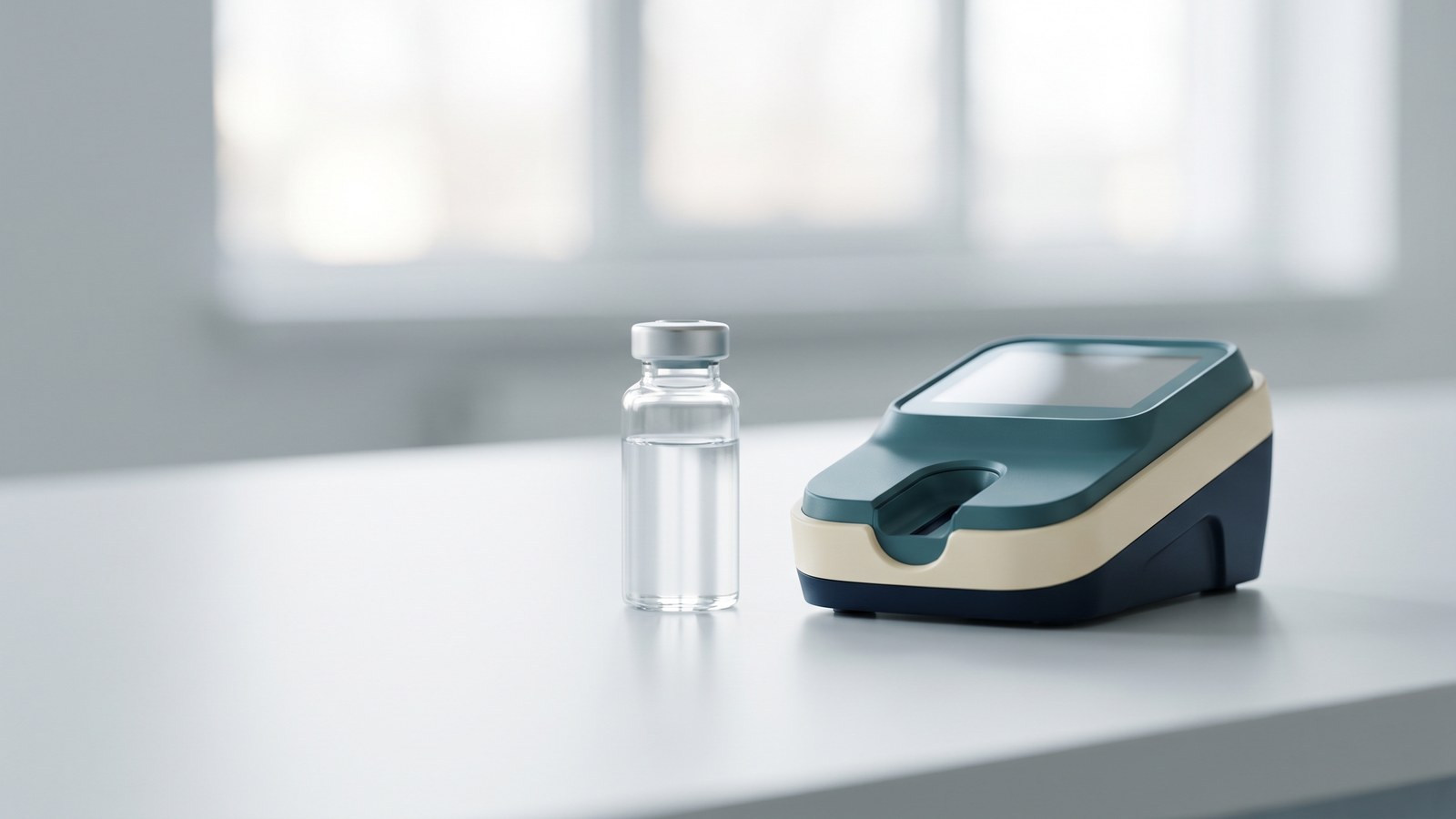
The control result has come back outside its limits. Perhaps one level tripped a 1-3s flag, perhaps both levels drifted to the same side of the mean on consecutive days. Either way the run is out of control, patients are waiting, and the analyser is still perfectly willing to print numbers. The urge to carry on testing is strong, and it is the one instinct to resist. A failed quality control (QC) result is the instrument telling you that, right now, you cannot trust the numbers it produces. The reassuring part: knowing what to do when quality control is out of range comes down to a short, ordered sequence. Work it in the correct order and you protect your patients, your records and your afternoon.
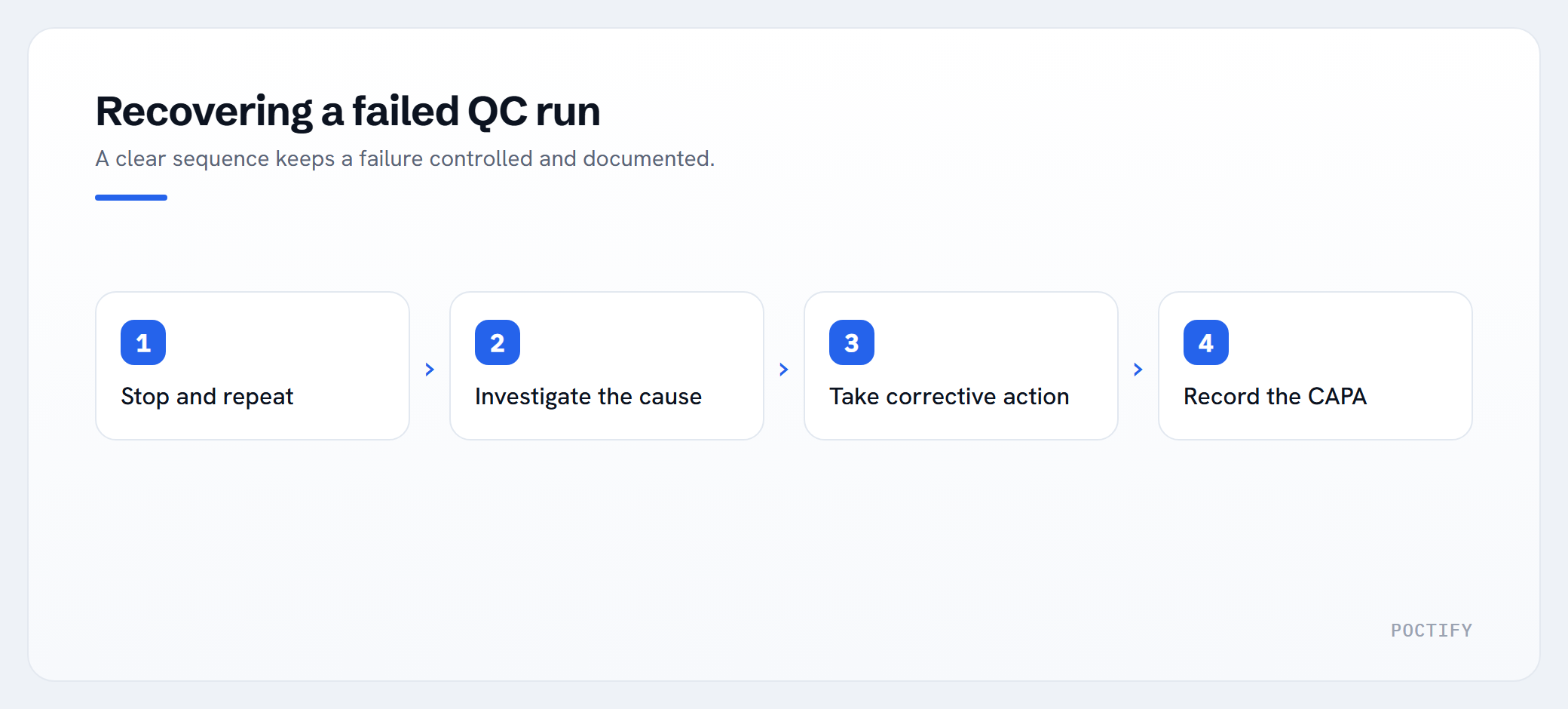
This article is educational and operational only. It is not medical advice and does not address the clinical interpretation of any patient result.
Step 1: Stop reporting and hold the results
Before you reach for a fresh control vial or open a new reagent, do the single thing that protects patients: stop releasing results from the affected test. Put the analyte, or the whole instrument if you are unsure of the scope, on hold. Any result generated since the last acceptable QC is now provisional, so it should not leave the bench, reach a clinician, or feed a treatment decision until you have resolved the failure.
This is uncomfortable when a clinic is busy, which is precisely why it has to be a fixed rule rather than a judgement call in the moment. A short hold of fifteen minutes is far cheaper than a wrong result acted on in good faith.
Step 2: Read the rule that broke
The QC rule that flagged is not just an alarm. It tells you what kind of error you are chasing, and that single read stops you troubleshooting at random.
Random error: a 1-3s or R-4s flag
A single control point beyond three standard deviations (1-3s), or two controls in a run spread more than four standard deviations apart (R-4s), points to random error, also called imprecision. Think one-off, physical causes: an air bubble or a clot, a short sample, inconsistent mixing, a hurried pipetting step, or a transient knock to temperature. Analytes sensitive to pre-analytical handling, such as potassium, are quick to show this kind of scatter.
Systematic error: a 2-2s, 4-1s or 10-x flag
Two consecutive points beyond two standard deviations on the same side (2-2s), four in a row beyond one standard deviation (4-1s), or ten consecutive points on one side of the mean (10-x) point to systematic error: a shift or a trend. These have settled causes: a new reagent lot, reagent that is ageing or has been stored badly, calibration drift, a control vial near expiry, or a lamp or sensor that has crept off its baseline. If you want a refresher on how each rule maps to a cause, see our guide to Westgard rules.
Step 3: Check the usual suspects, in order
Resist swapping parts at random. Work the list from cheapest and most likely to most involved.
Control storage and expiry
Check the control first. Is the vial in date, including its shorter open-vial life once reconstituted or first pierced? Was it stored at the right temperature, and has it been left out on the bench? A control that has warmed, evaporated or aged will fail honestly even when the analyser is fine. Confirm you are reading against the correct target range for that control lot, not a previous one.
Reagent and strip lot
Note whether the failure started exactly when a new reagent or strip lot went into use, the classic signature of a systematic shift. Confirm reagents are in date, were stored correctly, and that cartridges or strips are not from a damaged or previously opened pack.
Operator technique
Many failures are procedural, not mechanical. Was the control mixed as instructed, the right volume applied, the timing followed? If a different operator ran this control, a quick repeat by an experienced hand often settles whether technique was the variable.
Calibration status
Check when the test was last calibrated and whether anything has changed since: a new lot, a service visit, a power interruption. A drifting calibration is a common engine behind a slow trend.
Step 4: Repeat with a fresh vial
With the obvious causes checked, run a fresh control, ideally from a newly reconstituted or freshly opened vial of the correct lot. This separates a genuine analyser problem from a one-off bad control measurement.
If the fresh control passes and you can explain the original failure (a bubble, a tired vial), you have your cause. Document it and move on. If the fresh control fails too, the problem sits with the reagent, the calibration or the instrument, and you escalate.
Step 5: Recalibrate only when the evidence points there
Recalibration is not a reflex. Calibrate when the picture is a systematic shift or trend, when a fresh control still fails, or when calibration is genuinely overdue. Recalibrating to chase a single random flag can mask the real cause and reset a perfectly good calibration onto a bad reagent or control. After any recalibration, run QC again and confirm it passes before you even think about releasing results.
Step 6: The step clinics most often miss
Here is the part that gets skipped under pressure, and the one that matters most. A QC failure is not only about the next result. It casts doubt backwards, over every patient result produced since the last time QC was known to be acceptable.
So before you reopen the test, define that window: from the last good QC to the failure. List every patient tested in it. For each, decide on a clear action, and record it: repeat the test on a fresh sample, issue an amended report if the result changes meaningfully, or contact the requesting clinician where a result may already have been acted on. The size of the window is the strongest argument for running QC at sensible intervals: the longer you go between checks, the more results you have to reconsider when one fails.
This review is a clinical-safety task, so involve the lead or laboratory contact named in your local procedures rather than carrying the decision alone.
Step 7: Document the root cause and corrective action
Close the loop with a record a colleague, or an assessor, could follow months later. A useful entry captures the date and time, the test and control lot, the rule that broke, what you checked, the root cause you settled on, the corrective action taken (new vial, new reagent lot, recalibration), the patient results reviewed and what was done about them, and the QC result that confirmed recovery. This is the corrective and preventive action trail that quality frameworks such as ISO 15189:2022 expect a point-of-care service to keep. The standard describes the principle in detail, so use your accredited copy for the exact wording.
Let the log surface repeat offenders
One failure is an event. The same failure every third Monday is a pattern, and patterns are where the real fix lives. A paper logbook hides them; a digital QC log makes them visible. When each failure is captured in a structured form, you can see that one analyte, one reagent lot, one operator or one analyser is behind a run of out-of-control events, and act on the cause rather than the symptom.
This is where POCTIFY helps. The platform records QC outcomes, the recovery actions taken and the patient results reviewed in one place, and works with the devices and systems you already use, so a trend a single bench would never notice becomes obvious across the service.
What to do when quality control is out of range: a quick checklist
- Stop. Hold results for the affected test.
- Read the rule: random (1-3s, R-4s) or systematic (2-2s, 4-1s, 10-x).
- Check control storage and expiry, reagent lot, technique, calibration.
- Repeat with a fresh control vial.
- Recalibrate only if the evidence points there, then re-run QC.
- Review and, where needed, recall every patient result back to the last good QC.
- Document the root cause, the action and the confirming QC.
Handled in this order, an out-of-control run becomes a routine, defensible recovery rather than a scramble.
Talk to POCTIFY
If your QC recovery still lives on paper, or repeat failures are slipping past unnoticed, we can help you build a clearer process. Talk to POCTIFY about support tailored to how your clinic tests, with no pressure and no script.
Frequently asked questions
Should I report patient results while quality control is out of range?
No. Hold results from the affected test as soon as a control fails. Any result produced since the last acceptable QC is provisional and should not reach a clinician or inform a decision until the failure is resolved and QC passes again.
How do I know if a QC failure is random or systematic error?
Read the rule that flagged. A single point beyond 3 SD (1-3s) or a wide spread within a run (R-4s) suggests random error, often a bubble, clot or technique slip. Two or more points trending to one side (2-2s, 4-1s, 10-x) suggest systematic error such as a new reagent lot or calibration drift.
Do I need to recalibrate every time QC fails?
No. Recalibrate when the pattern is a systematic shift or trend, when a fresh control still fails, or when calibration is overdue. Recalibrating to chase a single random flag can hide the real cause. Always re-run QC and confirm a pass before releasing results.
How far back should I review patient results after a QC failure?
Back to the last QC you know was acceptable. List every patient tested in that window and decide an action for each: repeat on a fresh sample, amend the report, or contact the requester. Frequent QC keeps that window, and the review, small.
Why keep a digital QC and corrective action log?
A structured log records each failure, its root cause, the action taken and the confirming QC, and makes repeat patterns visible, like one reagent lot or one analyser failing again and again, so you can fix the cause rather than the symptom.